My pal Andy Hodges was on episode 116 of The Editing Podcast, talking about editing translated materials. It’s a great episode and it’s sent me down memory lane. If you know me, you wouldn’t necessarily associate me with the business of translation. And you’d be right. But I’ve been dancing around the edges of literary translation for quite some time. First as a reader. Then as a teacher. And now as an editor.
Reader
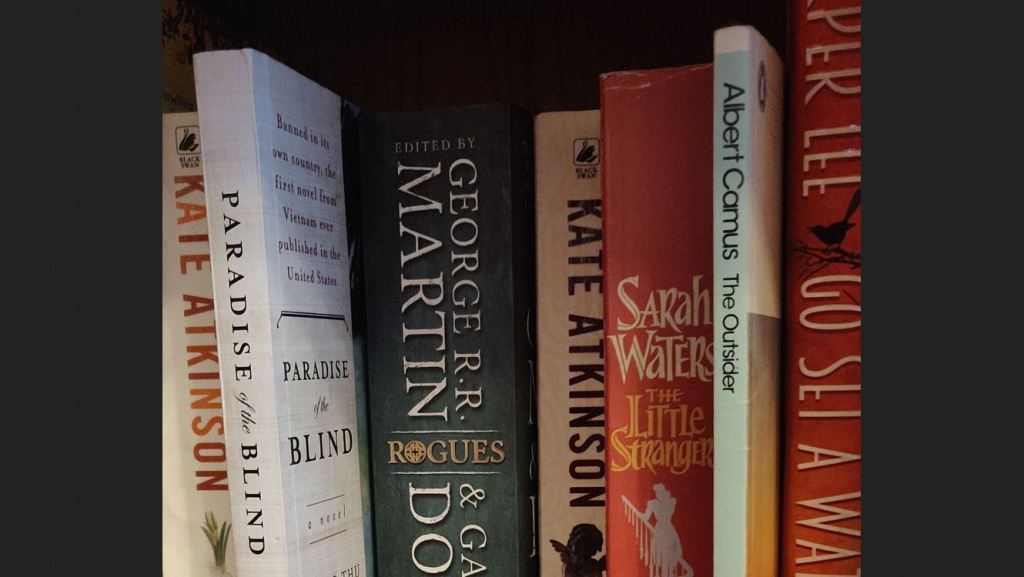
Have you read many texts in translation? It turns out I’ve read a fair few. Looking at my bookshelf next to me, I see ‘Paradise of the Blind’ by Duong Thu Huong and ‘The Outsider’ by Albert Camus. Both are excellent, by the way. I’ve got Gabriel Garcia Marquez’s ‘One Hundred Years of Solitude’ squirrelled away on another bookshelf somewhere in the house, and Carlos Ruiz Zafon’s ‘The Shadow of the Wind’. Oh, and various plays. ‘Hedda Gabler’ and ‘The Doll’s House’ by Henrik Ibsen. ‘Mother Courage and Her Children’ by Bertolt Brecht. And many others that are now dominoing through my mind library.
I may have read translations before I read ‘One Hundred Years of Solitude’, but if I did, I was unaware they were translations. But teenage-me could not fail to realise ‘One Hundred Years of Solitude’ was a translation. It was so different to all other literature I’d read by that point that I knew it must be from a tradition vastly different to my own. Turns of phrase; characters – names, appearance, attitudes, relationships; places; structure; the style of prose: everything was different. But I don’t remember thinking, at the time, that without the translation, I wouldn’t have been able to expand my cognitive and literary horizons to such an extent. That’s just something that adult-me has since reflected.
Educator
‘The Outsider’ is a text that came into my life when I was an educator. I taught it to International Baccalaureate students, so I know this book inside out. English A required students to study a text in translation. This was an excellent choice; it provoked so much discussion.
That it was ‘in translation’ was part of the point of the module – the IB loves students to consider global perspectives. My tutees had to think about the context of production and to what extent our reception of this novella could be influenced by it being a translation. This text is ripe for analysis in this regard, starting with its title.
‘L’Étranger’ is its title in French. The translation I taught was called ‘The Outsider’, but there are other translations available that call the novella ‘The Stranger’. If you know what transpires in the story, you perhaps have your own opinions on which is the more fitting title. My students certainly had a lot to say on the matter.
Editor
Now I’m an editor and not an educator, do I have any new perspectives on translations? Well, for the record, I’ve never edited any. And after listening to Andy’s guest appearance on The Editing Podcast, I’d think very carefully about whether I was the right person for the job if an opportunity like this came across my desk.
Let me explain.
Among the many things that Andy talks about in this translation-themed episode of Denise Cowle and Louise Harnby’s podcast is the nature of literary tradition. This is what provoked this reflective mood you find me in. It was excellent food for thought. The overarching point he makes is that if you’re involved in working on a text in translation, you should be aware of – and sensitive to – the literary tradition in which the author is writing. He was talking about editors who work on a translated manuscript, as opposed to the translators themselves, but it’s a given that they need to be au fait with the original, in terms of its genre, style, language, tone, etc.
Andy gives the example of Japanese Kishōtenketsu narratives. He says that if you are an editor from a tradition in which conflict is central to a story, you might be tempted to suggest edits to a manuscript to ensure conflict is present, whether that’s at the structural level or at sentence level. But if you do this as a developmental editor or a line editor to a work of Kishōtenketsu, that’d be the wrong call. Conflict isn’t the point of a Kishōtenketsu narrative, and to add it in would give readers a reaction to the text that wasn’t the author’s intention.
The author’s intention is what’s vital here and this should govern the professionals hired to translate manuscripts and to edit these translations.
You might think I’ve talked myself out of ever putting myself forward for opportunities of working on translated manuscripts. I haven’t. I’d be comfortable working on a translated manuscript in certain circumstances.
An English proofreader like me could proofread a translation. That’s literally just the final quality assurance check. Dotting the i’s and crossing the t’s. I could probably also copy edit a work in translation. I could look at consistency and styling. I could raise author queries for anything I felt needed double-checking. But what about line editing? Maybe. Maybe I could line edit a work in translation, but I think this is where things become more shaky. I could line edit a work in translation if the aim was to anglicise a text. I could wear the hat of the English reader and make sure things land correctly. But there’s definitely the risk that, in doing so, I could misfire. I’d probably say no to such a job – just in case. I’m sure there’d be another editor who’d be a better fit. Which leaves developmental editing, often the first stage of editorial intervention. Developmental editing is not a service I offer (yet). Watch this space. But would I developmentally edit a work in translation? Again, it depends what an author wants. If they want to see how something would land with an English audience, then sure. I could definitely give feedback on that. But if the point was to stay true to the literary tradition in which the author is writing – and if I’m ignorant of that tradition – then, no: I’m not the woman for the job.
So it’s fair to say this podcast episode has me thinking about what I say yes to. I’m more than happy to have translations in my life as a reader and as an educator. But I’d think carefully about whether I was the right fit to get involved in the editing of a translation.
I’d love to know your thoughts about this, whether you’re coming at the topic as a reader, an educator, an editor – or perhaps even as an author. Let me know in the comments. Let’s chat translations.
 CherryEdits