
Brian Terence is working with me again this month, which is always great fun. For almost two years, Brian has been sending me short stories for evaluation. He’s a fan of my manuscript assessment service, which provides an early editorial review to identify what’s going well with a narrative – and what needs addressing.
Join me as I chat to Brian about writing sci-fi, building connections in the publishing world, and developing his craft as an indie author.
1. For readers meeting you and your work for the first time, how would you describe your writing style?
Old-fashioned. Let’s be generous and call it classic. I grew up reading Wells, Asimov and many others; this has inevitably influenced my writing style. I’m not looking for something avant-garde, just a good story that I’d want to read myself.
2. What themes or questions are you most interested in exploring through your writing?
Simply put, I’m not. I don’t have a philosophy I want to promote or some ideology that needs to be expounded. My job is to entertain and occasionally give my readers something to think about. That’s where it ends. If I don’t give the little demons that live in my head some exercise, they chew the furniture.
3. What part of the writing process do you find most rewarding – and which part do you find most challenging?
Of course, I like it when I’ve finished. There’s a sense of accomplishment. But, in a way, that’s when the hard work begins, because you have to read it over and over again, checking for errors, a missed comma, and all those other little squiggles that some people think are so important.
4. You tend to work on short-form fiction. Why is that?
Partly this is influenced by the writers I grew up with, such as Asimov and Harry Harrison, who wrote both short stories and novels. Writing short stories is practical; you can submit them to competitions and magazines, etc. There are very few competitions for full novels. I’ve limited time, and a full novel takes a long time, months at least. I can get a basic draft of a three-thousand-word story done in a day, or at least a weekend. There are also the editing costs; a short story is a more manageable expense.
5. We’ve worked together on several of your short stories and a novella, all at the manuscript assessment stage. For writers who may not be familiar with this service, could you briefly explain what it involves?
I find this very useful, for a variety of reasons. The overview is helpful, and it picks up on plot holes. It looks at the manuscript as a whole, rather than focusing on line-by-line. Issues such as sensitivity are commented on, which is useful for a male author writing female characters.
6. How did the editorial feedback influence your next steps – either practically (what you changed) or creatively (how you thought about the work)?
The advice received has always been very helpful. I’d say I implement 90–95% of the suggested changes. It is useful to have an experienced eye reviewing my work. I personally find that it boosts my confidence about my writing generally and the individual piece specifically. For most authors, self-doubt and a fear of what people will say are what hold many back.
7. You are active on LinkedIn and BlueSky. What value do you get out of networking with other writers, editors and people in the publishing world?
LinkedIn is a good place for connecting with other authors and the publishing industry. Although I’m happy as an indie author, I still like to keep up to date with industry news. Sharing warnings about scammers and other bad actors is also a benefit of being active across social media. LinkedIn isn’t a great place for sales. I doubt many book sales come from LinkedIn directly, but that’s not what it’s for. The more people you interact with, the more opportunities open up. BlueSky and the other platforms are slightly different; it is more about sales and connection with potential readers. They need to feel a connection with you, and posting on social media is a part of that. BlueSky specifically has a strong sci-fi community, so it’s a natural place for me to share my interests and promote my writing.
8. You’re interested in submitting to magazines and literary competitions. What’s the draw?
Reputation and profile. Partly it helps to get a bit of feedback, which helps you to improve the craft of storytelling. Although rejection hurts, realistically, the odds of being accepted are low, so when it does happen, it boosts confidence that you are reasonably good at what you’re doing. Self-publishing is fine, but unless you occasionally test yourself against others, you’ll always have that doubt. Having a piece accepted is a reassurance that you actually know what you’re doing. There’s also the matter of profile. When your work is accepted for publication or you win a competition, it helps to boost your profile with potential readers and reassure them that spending money on your book is worthwhile, especially for a newbie.
9. You write speculative fiction. Do you read it too? How about other genres?
I mostly read sci-fi and related stories, sometimes history. I do listen to a very wide range of podcasts, on science and nature, astronomy, both for my own interest and as a potential inspiration for stories. I also listen to a lot of podcasts about the craft and business of writing, to improve my skills and keep up to date. I know some authors who’ve commented that they almost never read, which to me makes no sense. To be an author, you have to be an enthusiastic and prolific reader, especially in the genre you’re writing in. On my Goodreads, for example, there are over 400 titles that I’ve read, and that’s only the ones I can remember.
10. What’s next for you as a writer, and where can readers find your work or follow what you’re doing?
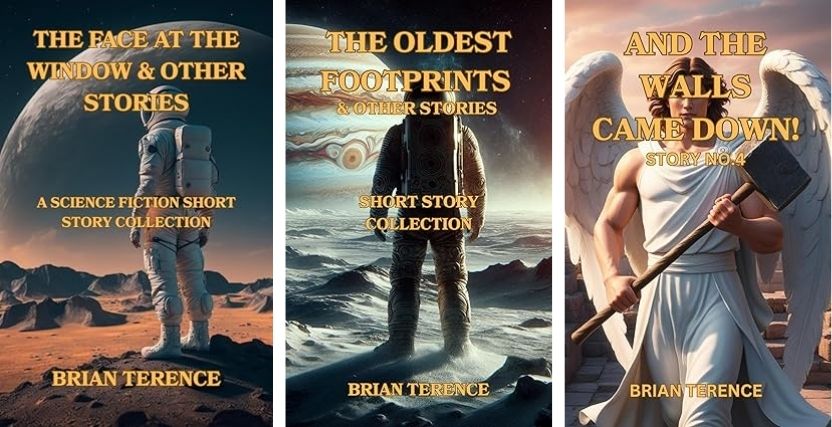
My next project is to release a reworked collection on a platform other than Amazon. This isn’t going to include much new work, but I want to move away from total reliance on any one platform, and I’m looking for wider distribution. After that, I’m intending to release a new collection on Amazon, probably around Jun ’26, which will be a dark & spicy collection. The working title is The Revenge of Saint Vitalis. People can follow me on the various social media platforms. As you say, I’m busiest on LinkedIn and BlueSky, but Goodreads is another place to follow me.
Thank you, Brian, for taking the time to share your thoughts. There’s a lot here that’s sure to interest indie authors, especially those who write in the speculative genres. All the best with your plans for wider distribution – and fingers crossed for the competition entries!
To follow Brian’s writing adventures, check out his Goodreads profile.

