#CraftBookMonday Menu

📌 Topic: Great dialogue is dialogue that’s unique to the character – December 16th, 2024
    Create Individuality in Your Dialogue

    One of the problems I see a lot is that the voices of the characters are the same throughout.

    You could hide the character's name, and you wouldn't know who's talking because it's all the same.

    It's basically the writer's voice.

    Great dialogue is dialogue that is unique to the character, and you can tell.

    A little trick you can use is to hide who's speaking.

    If your dialogue is individual and unique, you should be able to know who's speaking just by reading their dialogue.

And I've tried this trick as part of a coaching

📌 Topic: Coming up with character names – December 9th, 2024
It's #CraftBookMonday. I'm looking at a blog post today from jerryjenkins(dot)com
Jerry gives 8 tips for the naming of characters and 7 sources/methods to come up with names.
Do take a look if you're struggling to find the right names for your cast of characters.
https://jerryjenkins.com/character-names/
And I'd love to hear from you today, too – I'm nosy! Head to the comments with reflections on these questions.

    How did you come up with your character names?
    What comes first: the name or the personality?

Quick editorial tip from me:

    Avoid character names that start with the same letter. It can become very confusing for readers if you have, for example, Mark and Mike – especially confusing when the names are the exact same length too.

    Over to you: naming characters. How do you do it?

📌 Topic: No, adverbs don’t have to end in ‘ly’ – December 2nd, 2024

    It is true that “-ly” is used to make adverbs out of adjectives (gladly), participles (lovingly) and sometimes nouns (totally). That does not mean, however, that to be an adverb a word must end in “-ly,” as is believed by those who are irritated by signs that read, “Go slow.”

    Nor is the use of slow as an adverb a recent innovation; the OED dates it back as far as 1500. Like slow, many other adverbs have two forms.

    There are, for example, bad, badly; bright, brightly; cheap, cheaply; [...] sharp, sharply; tight, tightly; wrong, wrongly.

    It should be noted that although the words of some of these sets can be used interchangeably—“go slow” or “go slowly”—others cannot be so used. We cannot say, for instance, “The defendant was wrong imprisoned.”

    When there is a real choice and idiom does not require one form or the other, the tendency in reputable writing is to use the “-ly” version.

📌 Topic: Emotional distance, a guest post by Liz Hurst – November 25th, 2024
A week or so ago, I finished the first draft of a novel, so I'm now in that limbo period between desperately wanting to start typing it up (it's all handwritten in notebooks at present), effectively the first round of edits, and knowing that it's far too soon.
Yes, this morning I'm talking about Emotional Distance, a critical step when editing your own writing.
Here's a quotation from my book, The Wordsmith's Guide to Editing Your Own Novel:
"Imagine your book as an item about to be set on the barbecue. Your plan is to make this delicious dish with a great new marinade recipe you've just read and you want your party guests to enjoy it as much as possible. But a marinade is not an instant thing. Your dish needs time for your carefully prepared concoction to infuse in order to get the best possible result.
"Your book is the same. Although I'd recommend much longer than a few hours or overnight, unlike your chicken wings. More like three months."
Hope you like the analogy!
For more information, you can click on the book link in the comments.
Thanks again, Claire!

📌 Topic: Subtext captivates. Avoid ‘on the nose’ dialogue – November 18th, 2024

I'd highly recommend Robert McKee's book Dialogue. Here he is quoted in an article on the London Screenwriters' Festival website. (See link in comments.)

    It’s not as if you can’t write on the nose. If it’s appropriate for the character to say out loud what they are really thinking and feeling, then fine. But there always is a subtext underneath that. And that’s what keeps on the nose writing from seeming on the nose. The ideal of all dialogue is that it is a transparency, that no matter how long a character tries to say out loud what they are exactly thinking and feeling, the audience’s eye travels through the surface of the scene to the real thoughts, even subconscious thoughts and feelings that are going on underneath what the character is saying. That’s what’s the audience finds captivating—they know what’s really going on inside the character better than the character.

📌 Topic: What’s meant by “writer’s voice”? Are you aware of yours? – November 11th ,2024
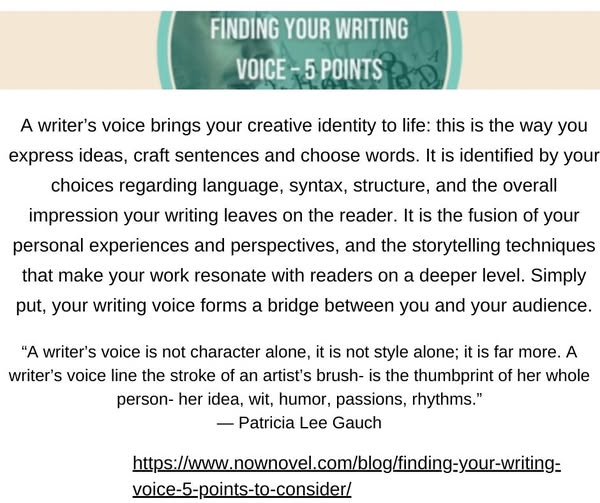
The 'Now Novel' blog says this:

    A writer’s voice brings your creative identity to life: this is the way you express ideas, craft sentences and choose words. It is identified by your choices regarding language, syntax, structure, and the overall impression your writing leaves on the reader. It is the fusion of your personal experiences and perspectives, and the storytelling techniques that make your work resonate with readers on a deeper level. Simply put, your writing voice forms a bridge between you and your audience.

And they quote Patricia Lee Gauche:

    A writer’s voice is not character alone, it is not style alone; it is far more. A writer’s voice line the stroke of an artist’s brush- is the thumbprint of her whole person- her idea, wit, humor, passions, rhythms.

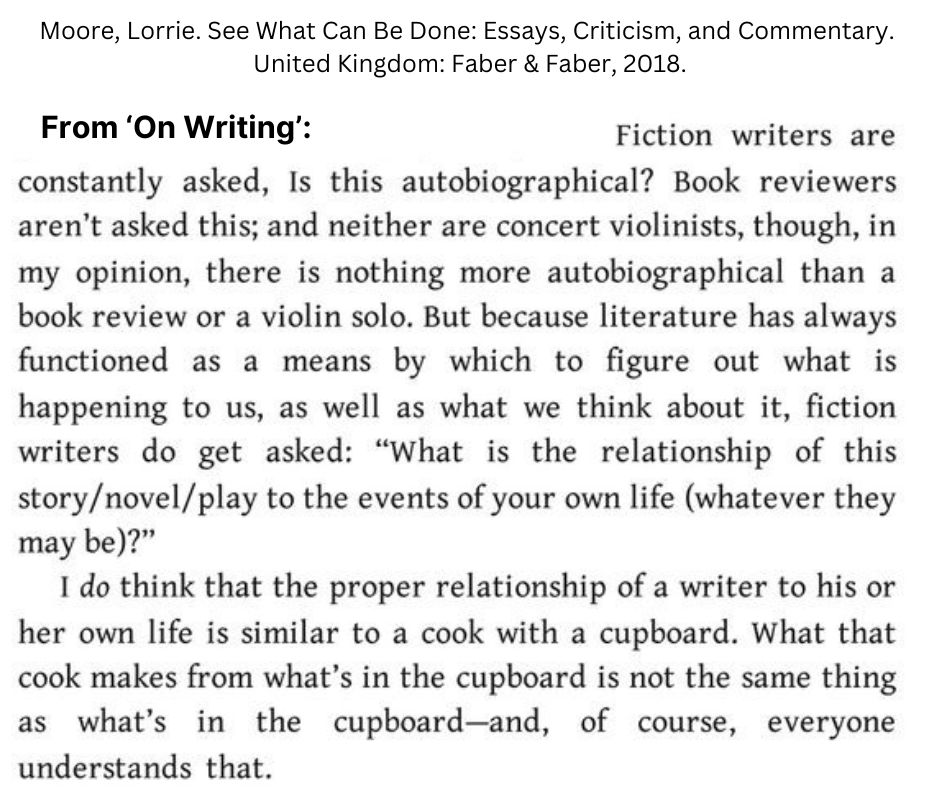
📌 Topic: to what extent is what you write related to what you’ve been through/experienced?Lorrie Moore: See What Can Be Done (2018) – October 21st, 2024


📌 Topic: Good vs. Poor Storytelling Robert McKee: Story (1997) – October 7th, 2024

📌 Topic: How to deal with the parts of writing that you don’t enjoy. K.M. Weiland: Helping Writers Become Authors (S16, E18) – September 30th, 2024

    Sometimes the resistance we feel to writing certain parts of a story may point [...] to our own lack of confidence in executing those parts...

    Ask yourself what they are trying to achieve at an artistic level with this technique. For example, if you’re working with description, you may begin to notice true wordsmiths are rarely “just” describing something at length. Rather, they may be intentionally using description to achieve other ends—everything from evoking symbolism and mood to furthering the plot or providing commentary on a character.

    You aren’t just seeking to become good at a specific technique, you’re seeking to master it—to understand its deeper purposes and uses, so you can employ it in your story...

📌Topic: Speculative fiction – “…death need not be the thing that matters.” Claire North: The Writers’ & Artists’ Yearbook 2024 – September 23rd 2024

… in speculative fiction, if you try to write yourself out of [a] plot-hole with an unexpected deus ex machina, there is a danger that you will undermine a reader’s immersion in what that world is. Don’t be afraid of deleting your way to freedom and take time to structure your story. Especially in speculative fiction, death need not be the thing that matters. In thrillers in the Chris Ryan vein, soldiers live and soldiers die, but betrayal hurts more than actual bullets. Gout doesn’t kill Falstaff; the betrayal of Prince Hal does. What matters to the story is not life or death, but what these things mean to our characters. Mount Doom erupting in Middle-Earth has nothing on Frodo succumbing to the dark side. Find what matters to your world and characters; obey your own rules.


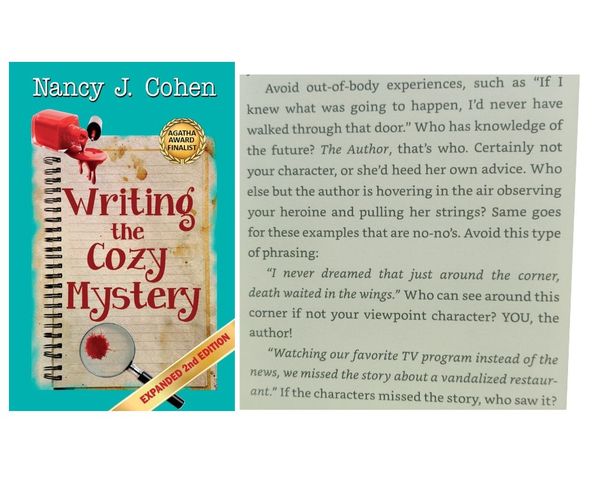
📌 Topic: What Does the Viewpoint Character Know? Nancy Cohen: Writing The Cozy Mystery (2018) – September 16th, 2024

    Avoid out-of-body experiences, such as "If I knew what was going to happen, I'd never have walked through that door." Who has knowledge of the future? The Author, that's who. Certainly not tour character, or she'd heed her own advice. Who else but the author is hovering in the air observing your heroine and pulling her strings? Same goes for these examples that are no-no's. Avoid this type of phrasing:

    "I never dreamed that just around the corner, death waited in the wings." Who can see around the corner if not your viewpoint character? YOU, the author!

    "Watching our favorite TV program instead of the news, we missed the story about a vandalized restaurant." If the character missed the story, who saw it?


📌 Topic: Ideas and Where They Come From. Stephen King: On Writing (2012) – September 8th, 2024
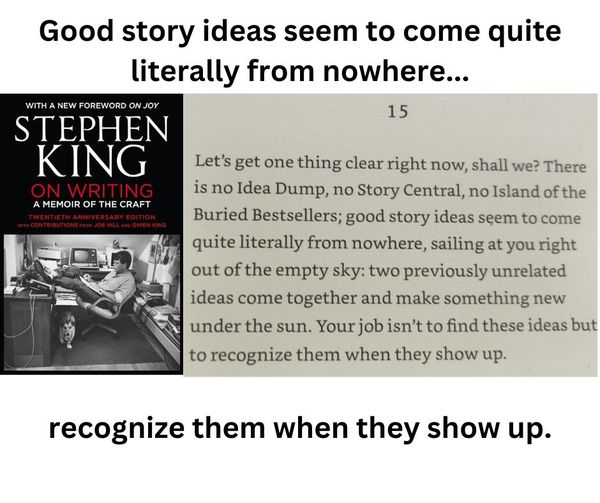
Let's get one thing clear right now, shall we? There is no Idea Dump, no Story Central, no Island of the Buried Bestsellers; good story ideas seem to come quite literally from nowhere, sailing at you right out of the empty sky: two previously unrelated ideas come together and make something new under the sun. Your job isn't to find these ideas but to recognize them when they show up.

📌 Topic: Characters and what they’re made of. Fay Weldon: Why Will No-one Publish My Novel? (2018) – August 26th, 2024


📌 Topic: “We remember not the art but the impact.” Donald Maass: The Emotional Craft of Fiction (2016) – August 19th, 2024

    How many novels have moved you to tears, rage, and a resolution to live differently? How many have left a permanent mark, branding you with a story that you will never forget? The number probably isn't great, and of that small number I suspect most of your memorable choices are not current novels but classics. What makes them classics? Artful storytelling, sure, but beyond the storytelling, classics have enduring appeal mostly because we remember the experiences we had while reading them; we remember not the art but the impact.

    When a plot resolves, readers are satisfied, but what they remember of a novel is what they felt while reading it. Hooks may hook, twists may intrigue, tension may turn pages, and prose may dazzle, but all of those effects fade as quickly as fireworks in the night sky. Ask readers what they best remember about novels and most will say characters, but is that accurate? It's true that characters become real to us but that is because of what they cause us to feel. Characters aren't actually real; only our own feelings are.

📌 Topic: Character Development at the Grocery Store. Flynn Berry: LitHub (2024) – August 12th, 2024

I always take my characters grocery shopping when I’m working on a novel. I like to push a cart around a supermarket, deciding what my character will buy. It’s the single best way for me to understand a character well enough to inhabit her on the page.
I need to know if my character shops for convenience or comfort. If she’s buying ingredients for elaborate recipes, or frozen ready-meals. I usually take her to a supermarket when I’m about a quarter of the way into a first draft. By this point, I know my character’s disposition, her internal weather, and I’m working out the particulars of her life: her job, her home, her routines. A supermarket trip can shake some of those pieces loose.

📌 Topic: Genre. Montgomery, Martin, et al.: Ways of Reading (2012) – August 5th, 2024
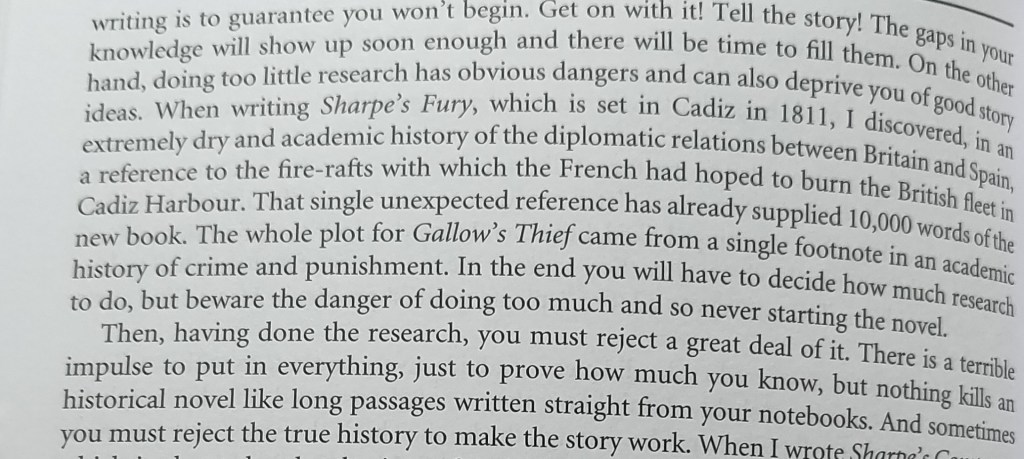
📌 Topic: Research and avoiding info-dumping. Bernard Cornwell: The Writers’ & Artists’ Yearbook (2014) – July 29th 2024


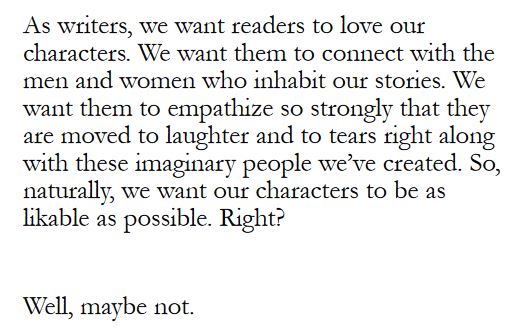
📌 Topic: Characters’ Likeability. K.M. Weiland: Crafting Unforgettable Characters – July 22nd, 2024

📌 Need vs. Desire. John Truby: The Anatomy of Story (2008) – July 15th, 2024
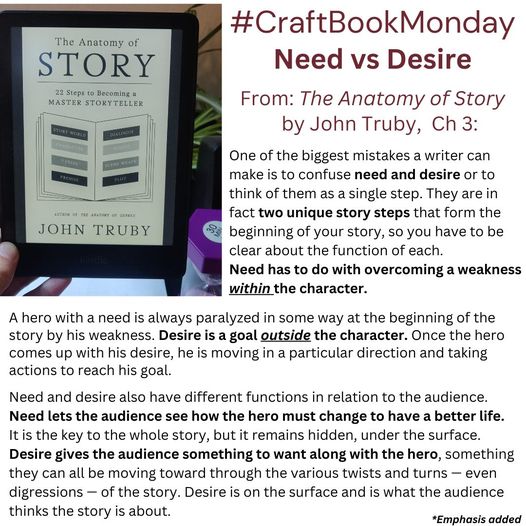
    One of the biggest mistakes a writer can make is to confuse need and desire or to think of them as a single step. They are in fact two unique story steps that form the beginning of your story, so you have to be clear about the function of each.

    Need has to do with overcoming a weakness within the character. A hero with a need is always paralyzed in some way at the beginning of the story by his weakness. Desire is a goal outside the character. Once the hero comes up with his desire, he is moving in a particular direction and taking actions to reach his goal.

    Need and desire also have different functions in relation to the audience. Need lets the audience see how the hero must change to have a better life. It is the key to the whole story, but it remains hidden, under the surface. Desire gives the audience something to want along with the hero, something they can all be moving toward through the various twists and turns — even digressions — of the story. Desire is on the surface and is what the audience thinks the story is about.

📌 Topic: Emotionally resonant fiction. K. M. Weiland: Helping Writers Become Authors (S16, E8)

    Emotions should never be copy/pasted into a story. The most resonant stories are those that create their own emotions. Most of the time, we will begin a story with an idea about character or plot or theme, and pertinent emotions can arise from there. Occasionally, we may start with an emotion (e.g., “I want to write a story about grief” or “I want to write a story about falling in love”). In those cases, it is imperative we shift into the mental space long enough to carefully choose and craft plots and characters who would naturally generate these emotions.

    In order for readers to feel what your characters are feeling, the emotions must arise naturally. Simply telling readers that a character is “sad” or “madly in love” will never achieve the desired effect. For emotions to be powerful, they can never be on the nose. This is why I have often used the personal mantra "never name an emotion.” This isn’t meant to be taken literally; sometimes you have to call out what a character is feeling. But naming an emotion should be a last resort. Instead, your character’s emotions should be deeply and achingly obvious from the context of their actions and the subtext of their reactions.

📌 Topic: Levelling-up your writing. Brandon Sanderson, BYU Lectures (2013) – July 1st 2024
📌 Topic: Point of View. Lisa Zeidner: Who Says? POV: Who Says? (2021) – June 24th, 2024
📌 Topic: Scene technique. Lisa Possio: The Editing Podcast (Ep 126) – June 17th, 2024
First drafts are really more for building than for writing and so you need to just get it down so you have something to work with. You need your materials first. And then you can go back and figure out: 'Oh, this little bit of information here, this was really mostly for me to figure this out.' Readers don't need to see this. And the way you can tell that is by knowing what scenes can do and what scenes should do.


📌Topic: Reading as a Writer. Cathy Rentzenbrink: Writers’ & Artists’ Yearbook 2023 – June 10th, 2024
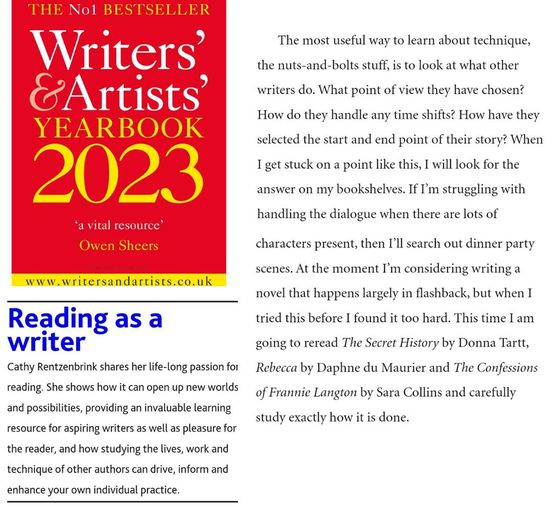
The most useful way to learn about technique, the nuts-and-bolts stuff, is to look at what other writers do. What point of view have they chosen? How do they handle any time shifts? How have they selected the start and end point of their story? When I get stuck on a point like this, I will look for answers on my bookshelves. If I'm struggling with handling the dialogue when there are lots of characters present, then I'll search out dinner party scenes. At the moment, I'm considering writing a novel that happens largely in flashback, but when I tried this before I found it too hard. This time I am going to reread The Secret History by Donna Tartt, Rebecca by Daphne DuMaurier and The Confessions of Frankie Langton by Sara Collins and carefully study exactly how it is done.

📌 Topic: Clichés. Lisa Cron: Story Genius – June 3rd, 2024
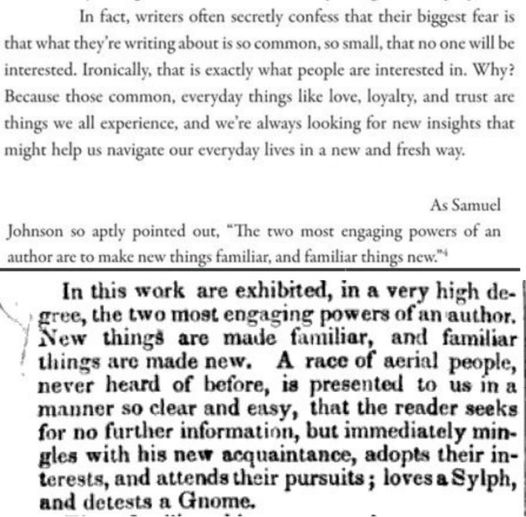
    Writers often secretly confess that their biggest fear is that what they're writing about is so common, so small, that no one will be interested. Ironically, that is exactly what people are interested in. Why? Because those common, everyday things like love, loyalty, and trust are things we all experience, and we're always looking for new insights that might help us navigate our everyday lives in a new and fresh way.

...

    As Samuel Johnson so aptly pointed out, "The two most engaging powers of an author are to make new things familiar, and familiar things new."

📌 Topic: Highly Crafted Language Problems. Lisa Cron: Story Genius (2016) – May 27th, 2024

“Rather than inviting us in, the beautiful language is more like a waterproof sealant, locking us on the surface where all we can do is admire the words, rather than absorb the story that they’re meant to tell.”

📌Topic: Formula or story DNA? Jessica Snyder: Save The Cat! Writes a Novel (2018) – May 20th, 2024

📌 Topic: Antagonists vs Villains. Christopher Vogler: The Writer’s Journey (2007) – May 13th, 2024

📌 Topic: Write the blurb first. James Scott Bell: Plot and Structure (2004) – April 29th, 2024

When you are comfortable with your LOCK elements [Lead, Objective, Confrontation, Knockout – a system to work out a basic plot, as described earlier in the book] move on to the writing of your back cover copy. This is the marketing copy that compels a reader to buy your book. This is what you see on the back of paperback novels in your bookstore.
What you want to do is create a few paragraphs that excite your own interest, enough to compel you to move on to the next step. You can even pause at this point to share your back cover copy with some friends to get their take on it. If no one can see the excitement in the story, you have the chance to rework things before spending all that time writing an outline.