
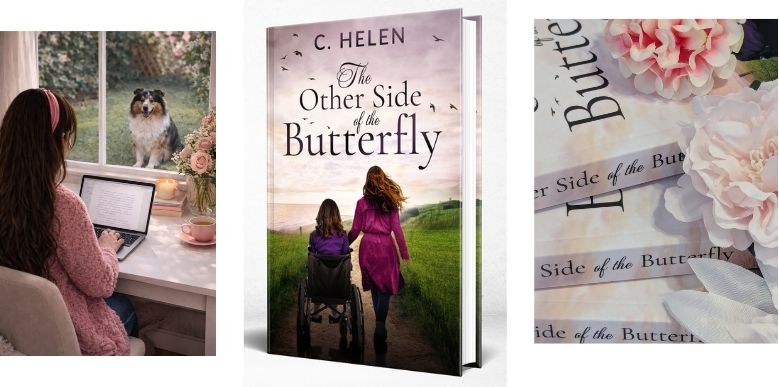
I first came to know C. Helen’s work when she entrusted me with the line and copy edit of her debut novel. From the outset, it was clear that this story was written with both courage and care – and that it didn’t shy away from uncomfortable truths. This is the story of the ripple effect of chronic illness, and I’d love for you to get to know the author behind it.
To start, can you tell us about your novel – what it’s called, what kind of story it is, and the kind of readers you think it will appeal to?
My debut novel is called The Other Side of the Butterfly. The Braxton sisters, Grace and Melody, are grappling with lives fractured by chronic pain, mental health struggles, and toxic relationships.
Grace, once a driven professional, is now confined by her debilitating illness and the scepticism of a medical system that questions her reality. Melody, tethered to a destructive romance and her own insecurities, fights to prove her worth while battling feelings of inadequacy. As their worlds unravel, both sisters are forced to face painful truths about love and loss and what it means to start over. Through grief and heartbreak, they begin to rediscover hope and resilience – and the courage to rebuild when everything seems lost.
My novel is a poignant contemporary story that explores the bond between sisters and the weight of invisible illness. It will appeal to readers who enjoy thoughtful contemporary fiction centred on complex characters and deeply human experiences.
Several people living with chronic illness have told me they recognised themselves in Grace’s story, and knowing the book has helped readers feel seen is something I value deeply.
The main character in your novel lives with chronic illness, and you have spoken openly about your own health challenges. Did your personal experiences help you write this part of the story?
Yes, they did. From a young age, I was a carer for my late mother, who lived with a progressive neurological condition and early-onset dementia. I grew up navigating the British health and social care systems.
Later, I worked as an occupational therapist, supporting people living with long-term health conditions, and I specialised in mental health. Alongside this, I have also experienced healthcare and associated authorities from the perspective of a patient since my teenage years, which has given me a very personal understanding of the challenges many people face.
Grace’s story was shaped by many of these experiences. It draws not only on my own journey, but also on what I witnessed as a young carer, as a health professional, and through conversations with other people living with chronic illness who kindly shared their experiences with me. Their stories were always treated with care and confidentiality, and they helped shape the emotional truth behind the novel.
While Grace is not me, writing her character allowed me to explore many of the realities people face when living with chronic illness, including the experience of medical gaslighting, while also showing the resilience people find as they try to rebuild their lives – the strength it takes to keep believing in better days.
Family relationships are very important in the book, especially between the sisters Grace and Melody. What made you decide to focus on a sister relationship in your story?
Although I am an only child, I have been very fortunate to have sister-like relationships throughout my life, particularly with my cousin and with close friends who have been part of my life for many years. Those relationships have had huge impact on me, and they helped shape how I thought about the bond between Grace and Melody.
Sister relationships can be strong, but they can also be complicated. People who grow up together often share the same history, yet they can experience life differently and struggle to understand each other’s perspectives.
In my novel, Grace and Melody both love each other, but they are also dealing with their own pain and challenges. Grace is trying to navigate life with severe chronic pain, while Melody is battling her own mental health struggles and destructive coping mechanisms. Melody Is often flooded with emotions and thoughts that overwhelm her, and because of this, the sisters sometimes misunderstand each other.
Ultimately, the sisters and other main characters show how chronic illness and adversity can test important relationships, but also how those experiences can bring people together.
The book shows strong emotions, and sometimes the characters behave in ways that are not always kind or easy to like. Why did you decide to show these difficult moments rather than soften them?
For me, it was important to show the realities of human life, especially in difficult circumstances.
We often see polished versions of life presented in public spaces and on social media, but real life is far more complicated than that. People make mistakes; they react emotionally and sometimes hurt the people they care without meaning to.
I wanted the story to reflect that reality. The characters are not perfect, but they are human, and their struggles are part of what makes their journeys meaningful. Showing those difficult moments felt important because it offers a more honest representation of what life can be like for many people.
The cat sanctuary is a lovely part of the setting. What gave you the idea for that? And are you a cat lover yourself?
The idea for the cat sanctuary came from wanting to create something that reflected Aunt Bella’s compassionate nature. She is a warm and caring character, and a sanctuary that looks after elderly, disabled, and often unwanted cats felt like a natural extension of that.
Cats are often misunderstood and sometimes seen as unfriendly, when in reality they can be beautiful, intelligent, and very affectionate companions. I wanted to include a place that recognised their value, especially those cats who might otherwise be overlooked.
And yes, I am a cat lover. I was lucky enough to have a wonderful cat by my side while writing this novel, even if she did insist on sleeping on the keyboard from time to time.
Grace has a close friend she first connects with online. Have you also found friendship or support through people you met on social media or in online communities?
Yes, I have. Living with chronic illness can sometimes be isolating, and online communities can offer a space where people connect with others who understand what they are going through.
I have met numerous kind and supportive people through social media, and those connections have become wonderful friendships. At the same time, online spaces are not always straightforward, and not everyone we meet turns out to be who we expect them to be. That complexity was something I wanted to explore through Grace’s experiences.
Like many things in life, online communities can hold both kindness and negativity. But they can also create new opportunities for learning, creativity, purpose, and relationships that may not otherwise have been available to people living with chronic illness or similar circumstances.
While writing the book, you worked with a writing mentor. How did that help you during the writing process?
I come from an academic and medical background, so moving into creative writing was a significant change for me and a steep learning curve. Writing fiction requires a very different way of thinking about storytelling, character, and emotion.
Alongside that, I live with a neurological condition and dyslexia, which means there were sometimes mistakes or structural issues that were difficult for me to spot on my own. Having a mentor like Lis McDermott, who is kind and patient, made a huge difference during the writing process.
Lis helped guide me through the craft of storytelling and encouraged me to keep developing the manuscript even when the process felt challenging. Her support and insight helped me grow in confidence as a writer and played an important role in shaping the novel.
Later, you asked me to carry out a line and copy edit on the manuscript. There are many editors online, so what made you decide to work with me?
My writing mentor, Lis McDermott, recommended you to me, and I trusted her judgement. When I first looked into your work and spoke with you, it quickly became clear why she had suggested you.
I appreciated your professionalism and the thoughtful way you approached the manuscript. It was important to me to work with someone who could help strengthen my writing while still respecting the heart and voice of the story.
Your feedback was detailed and constructive, and it helped me see areas where the writing could be clearer and stronger.
After the edit, you also booked a follow-up Zoom session so you could ask questions and talk through the feedback. What made you want to do that, and did it help you learn more about writing craft?
The edit itself was detailed and helpful, and I learned a lot simply from reading through the feedback. Because this was my first novel, I wanted to make the most of the opportunity to learn from it.
Booking the Zoom session allowed me to ask additional questions and explore some of the points in more depth. Talking through the feedback helped me better understand the reasoning behind certain suggestions and how I could apply those lessons to my writing.
I found the conversation valuable, and it helped me gain a deeper understanding of the craft that I can carry forward into my future work.
Where can readers find you online if they’d like to follow your writing journey? And are you working on anything new at the moment?
Readers can follow my writing journey on social media under C.Helen Author or via https://linktr.ee/c.helenauthor, where I share updates about my writing, the realities of creating stories while living with a chronic condition, and my volunteering with Cards 2 Warriors. I write supportive cards to people living with chronic illness via the charity.
I have been entering my novel and several short stories into writing competitions. Alongside that, I have been trying to learn more about social media marketing, which has been a huge learning curve but an important one as a new author.
I am also working on a new novel. Although it is a different story, it will include disability and chronic illness representation again, which is something I feel strongly about bringing into fiction.
Thanks so much for taking part, C. Helen – a fascinating insight. For readers who are interested in taking a look at your book, here is the link to the Amazon listing.
 CherryEdits