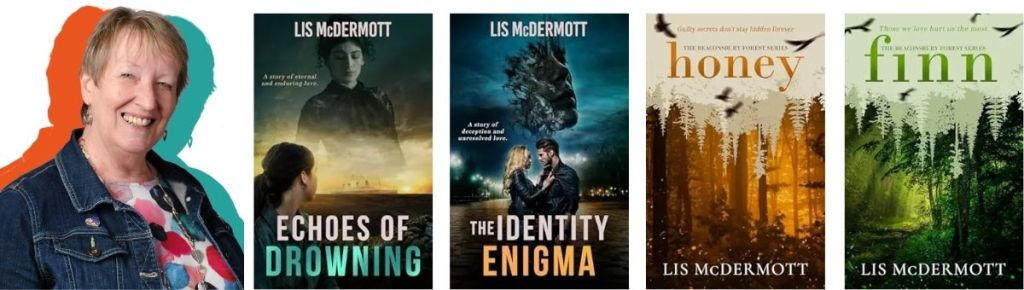
Lis McDermott – what a journey we’re on together. Lis and I have worked together since summer 2023, and over that time we’ve developed a strong editorial relationship. I can now leave almost shorthand comments in the margins of her edits and she’ll know exactly what I mean.
But it’s taken time and effort to get to this point of efficient communication. That, really, sums up why we work so well as an author–editor duo. We communicate clearly (even in shorthand!), so there are no misunderstandings, and so Lis remains firmly at the helm of her craft, with editorial input supporting that rather than taking over.
It’s a pleasure to work together like this, and long may it continue. Sit back and enjoy a chat with Lis:
1. Before becoming a novelist, you had a varied and creative career, from training primary school teachers in the music curriculum to working as a photographer. Are there particular skills from those roles that have influenced the way you approach writing fiction?
My varied work – as a secondary music teacher, a schools music adviser across the age ranges, as an OFSTED inspector and then as a wedding photographer, means I have worked with such a huge range of people, from different walks of life, from different backgrounds. This has definitely helped me to create my characters. During those different situations, I also witnessed how people see and experience life – which has helped immensely. Plus I’ve been told I’m a very empathetic person, which I think helps me when I write. Also, I’ve got a lot of years of living behind me, experiencing a whole range of emotions.
2. You write across forms – novels, poetry, and short stories. What do you enjoy about working in these different forms?
I haven’t written any short stories (apart from the prequel to my first novel) since the first book of short stories in 2018. When I first wrote my book of short stories, I didn’t understand how hard it is to write a short story well. They are not a genre I generally enjoy reading, so haven’t felt the urge to write them again.
Novels: I love creating characters, places (generally rather than using those that exist already); I enjoy writing dialogue a great deal and always read the interactions between my characters aloud – which at times must sound funny, especially when characters are arguing! There’s something so rewarding creating a community within a book.
I love poetry for the play on words, the rhythm, and particularly the challenge of writing in different poetic forms. When reading poetry I prefer it to be accessible – what I mean is, when you get to the end, you don’t wonder: What the hell was that all about!
I’m probably not a particularly intellectual poet – though, I’m not aiming to be. People often say they don’t like poetry and were ‘put off’ it at school. I see it as an expression of feelings, sometimes involving rhythm and rhyme, and on other occasions – a free fall of words and emotions.
3. The first piece of yours I edited was a short story, Imperfect Perfection, in 2023. Was that a deliberate ‘test run’ to see what I was like to work with before committing to a full novel!? And what did you end up doing with the story – selling it as a standalone, including it in a collection, or using it as a ‘reader magnet’ or bonus feature?
Imperfect Perfection was in fact meant as a reader magnet/bonus feature, which I actually haven’t used yet. It certainly wasn’t to check you out – I knew from speaking to other people that you were a good editor!
I really should do something with it…
4. The first novels I edited for you (Echoes of Drowning and The Identity Enigma) blend women’s fiction with mystery, while Honey and Finn move into family saga. When you begin a new project, are you consciously writing within a genre, or are you following character and story first and allowing the genre to reveal itself later?
When I write, I admit, I’m not good at writing to a genre – I know I should in terms of marketing, but an awkward part of me wants to write what I want to write! With each of my books, I’ve had an idea for the story I want to tell, then I develop the characters. I love writing about relationships, but I also like a bit of mystery.
5. You say on your website that you like putting your characters through some jeopardy – grief, loss, real emotional challenges – but you don’t leave them there. Why is it important to you that love, or hope at least, wins through?
Why is it important that love or hope wins through? I’m an optimist at heart and generally see the good side of things. As schmalzy as it may sound, I’ve been lucky enough to find the love of my life, so I like to write about people finding love or hope. However, not everyone comes out of my books alive, and some of the relationships are not straightforward! I like to represent real life, and we all suffer grief and loss at some time in our lives, so it would be unreal not to write about it.
6. At the time of writing, you’re currently out in Hong Kong. Does travel give you inspiration for future stories, or is travel more of a complete switch-off for you?
Sometimes travel does give me inspiration – I see something and think, That’d be useful to use in a book, but I don’t go away with the idea of finding inspiration for stories in a particular place. This time the trip to Hong Kong has definitely been a complete switch-off. However, I’m sure some of the situations and interactions I’ve seen between people will creep into a story somewhere.
7. I see online that your book launches are warm and well-supported, and you clearly enjoy reading your work aloud. What does performing your writing give you that the solitary act of writing does not? Has an audience response ever made you see a particular scene in a new light?
I love my book launches and I’m very grateful for the amazing support I have locally. Although I wouldn’t have thought it growing up, as I was not overly confident – as a musician, I’ve always enjoyed performing to a certain extent – but now I do so with far more confidence. As a teacher, I performed in front of students and then teachers, when I ran courses. As a wedding photographer, there’s definitely an aspect of performance when you have so many people to deal with – in an organising, friendly yet professional manner. So, being able to read parts of my book is something I enjoy.
I’ve not really had a response when I’ve read that changed my view of a scene, but sometimes when people talk to me about what they enjoyed, or noticed in the book, they see things I haven’t even considered – which always surprises me.
8. As a writing mentor, you’ve supported newer writers in finishing their manuscripts. What’s the most common hurdle you see, and what practical advice do you tend to offer to help them reach ‘The End’?
Working with new writers is amazing. After an initial meeting with them, if they haven’t even started writing, I encourage them to get words down on paper without worrying too much about it being ‘correct’. As someone famous said – ‘It’s difficult to edit an empty page!’ [Editor comment: ‘You can’t edit a blank page’ is often attributed to Jodi Picoult.]
A hurdle for many people is ‘finding their voice’ – they think they should use long words because they’re writing a book, rather than use the vocabulary they’d usually use. For example – I entered the room and surveyed my surroundings. That might be fine for someone who speaks like that all the time, but if the story is set in the present day and the character is a teenager they probably wouldn’t speak like that.
Another common problem is that people often switch tenses throughout, or they don’t understand who is leading a specific scene (something I’ve become even more focussed on, since working with you, Claire).
I see my main role as mentor, as empowering people to get their words down on the page and finish their book ready to hand over to a professional editor.
9. I’m soon to edit the fifth novel you’ve entrusted to me, which feels like a milestone worth celebrating. What keeps you coming back to Cherry Edits, and what do you value most about our ongoing editorial relationship?
My fifth novel edited by you is my sixth overall and I certainly wish I’d had you edit my first!
I love the way you edit. Your feedback is incredible – in far more detail than my previous editor and in comparison to some of my author friend’s editors. You always explain clearly why you’ve made changes (although I sometimes still get bits wrong, i.e. ‘dangling modifiers’). [Editor comment: More on this here.] The different formats you provide are very useful too. Most importantly, I’ve learnt so much from working with you and feel that my writing has improved no end.
Plus, I know that I can always contact you to ask you about other aspects of writing, and you offer support in other areas too.
I can’t imagine working with anyone else.
10. Finally, for readers who’d like to keep up to date with your books, events, and future releases, where’s the best place to find you online?
People can find me on my website and on social media.
Lis’s links: Website | Facebook | Instagram | Threads
Thanks for this, Lis. I’m looking forward to your next manuscript landing in my inbox. Best of luck with the final push.
 CherryEdits