
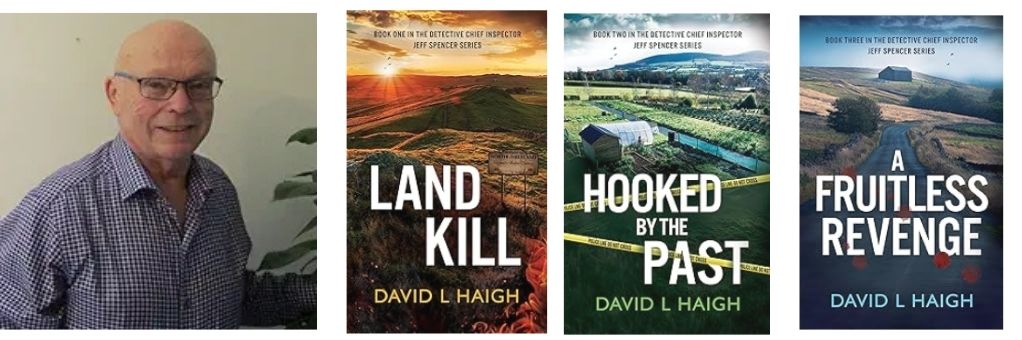
David Haigh writes crime novels set in the border country – Cumbria, Northumberland and, at times, southern Scotland. When he approached me last year to work on Land Kill, followed by Hooked By The Past and A Fruitless Revenge, I was glad to be involved, not least because of the strong sense of place running through his work. Set in the north of England, close to where I grew up, his novels bring a distinctive rural landscape to life.
Below, David shares his thoughts on his writing, inspiration and process.
1. Your crime novels follow DCI Jeff Spencer as he investigates cases in the border country around Hadrian’s Wall. Why did you choose to put DCI Spencer in a rural setting rather than an urban one – and why, specifically, this location?
The idea for Land Kill (1st in series) came from a memory way back in my student days (1971–72). I often visited the King’s Head in the village of Sandon. A chain-smoking regular called Ron had been a stockbroker in Threadneedle Street. He had opted out of the City rat race and moved to rural Essex to raise game birds.
I kept the rural setting and a character who raised pheasants and partridges on a smallholding, but moved the location to Hadrian’s Wall. Having lived in Carlisle for twenty years, it was an area I was familiar with and close enough to visit from our present home to absorb the atmosphere and register mental pictures with which to add authenticity to my descriptions.
DCI Spencer appeared after the death of a poacher. It was only then that I realised the story was turning into crime fiction. An outline plan followed, and the rest grew. It was only recently that it was pointed out to me that rural crime is receiving more attention in crime fiction writing, whereas urban crime has been covered extensively.
2. DCI Spencer is not only a detective but also a keen gardener, much like yourself. Which of the detective’s gardening traits or habits are closest to your own, and have you ever used time in the garden to solve a plotting problem?
Like me, Spencer has an allotment. I have referred to his time on his plot as somewhere he is able to relax and, occasionally, through his musings or something a neighbouring plot holder says, unearth a clue or the answer to sticky issues in an investigation.
3. What does a typical writing day look like for you? Do you work to a set routine, with fixed hours and word count targets, or do you just go with the flow?
I try to follow a scheme for my writing days, but often life gets in the way. I get sidetracked and spend more time in the garden or the allotment. So far as word counts go, I do check these regularly, and when I reach a quarter or halfway through a book, it feels good, feels like progress, and gives me a boost to continue.
4. You attend a local writing group. In practical terms, how does that group help you? For example, do you share drafts, discuss craft, or do you mainly use it as a motivator to get writing done?
Stewartry Writers meet twice a month. During the meetings, we read a piece from last time’s homework (if we’ve done anything). Other members comment/make suggestions. After a tea break, whoever is chairing the meeting comes up with a prompt for the group to write for twenty minutes. We then read our attempts.
We have had a few training sessions during my time in the group. It is something I would like more often.
5. The core team around DCI Spencer, including Bernie Holland, Paul Jordan and Bev Jacobs, remains largely consistent from book to book. Does that continuity make the series easier to write, or does it create challenges as you strive to maintain detail and consistency across the novels?
I am trying to develop the characters of the core team by adding relevant/related aspects into each additional novel without just dumping information. As an example, DCI Spencer is becoming less tolerant of the antagonists as their crimes become more violent. He has considered early retirement, but to date his drive for justice has won the day. Sergeant Jordan may move to a larger station, and PC Holland may take over as Sergeant at Sandon Bridge – all maybes at the moment.
I am trying to show not only the undesirable qualities of the antagonists, but point out any redeeming features or reasons why they have turned out like they have, to show that no one is all bad.
6. I know you as a crime writer, but I am aware that you’ve worked on some nonfiction too. Are your reading habits broad as well? Do you read a mixture of fiction and nonfiction, and for the fiction, is it mainly crime?
I really must read more and broaden my horizons. Most of my fiction reading in recent times has been crime-based. I tend to use my garden books less often and mostly for reference purposes. The trouble is most are regurgitations of previous gardening books. I am interested in attempting a new slant on writing a gardening book, which looks at the changes that have taken place in the way we garden over my lifetime. I did think I could write my 4th DCI Spencer novel and a gardening book at the same time, but abandoned the idea as too much for my brain to cope with.
7. From your second book onwards, we’ve worked together on a line and copy editing basis. For any newbie writers who don’t really know what this line/copy editing service is, how would you characterise it? How does the manuscript look or feel different when it comes back to you after its line and copy edit?
Your line/copy editing gave my writing much better structure. The way you rearranged some of my sentences and removed unnecessary words made the writing punchier without losing any of the meaning I was trying to get across. Most importantly, it was still presented in my style, the way I write. It was still my voice, but it was clearer. I hope that I learn and put into practice some pointers which you highlighted. Leaving gaps on the page for the reader to catch their breath when changing location and/or scenes is something else I have taken on board.
8. Your covers are strong and consistent across the series. How did you find your cover designer, and what kind of brief do you give them?
I found the book designer (Bespoke Author) through Google. Peter does the covers and Caroline the formatting, etc. I was impressed by their covers. They arranged for an introductory talk with me on Zoom when we discussed what my books were about and where the novels were set. I explained that I wanted the covers to show a theme running through the series and to highlight the Northumberland rural setting. Peter was happy to make any changes I felt were needed until we got it right.
9. What can you tell us about your current work in progress? How is DCI Spencer faring? What kinds of challenges are you throwing at him this time?
Jeff Spencer is finding the deaths of several police officers hard to take in the 4th book. Even thinking that maybe he should have retired after the last traumatic investigations. But he is not a quitter and will, with DI Bev Jacobs’ calming influence and encouragement, see the job through. However, the worst is still to come, so time will reveal how Jeff fares.
10. For readers who would like to keep up to date with your books and future releases, where can they find you online?
My online presence is my Achilles heel. I must work on this, but it seems like a constant, repetitive battle. I have an Amazon author page which I keep trying to improve and a Facebook author page – Keep Write On David L Haigh Author Page. My trouble is I don’t really understand what it is I should be doing to publicise my books online.
[Editor comment: I wonder, David, whether you might find some advice in the Indie Author Magazine? Or perhaps the Alliance of Independent Authors podcast might give you some ideas? Build Your Author Brand – the website run by Isabelle Knight – also has a range of resources. Best of luck.]
Thanks, David, for your interesting answers. Jeff Spencer feels very real to me now, and I’m looking forward to seeing how he’s getting on when I edit your fourth novel during the summer.
 CherryEdits
One thought on “Author Spotlight: crime writer David L Haigh on character, setting and storytelling”